

Translational Science Benefits




Summary
Septic shock is a life-threatening condition that can happen when your body has a severe reaction to an infection. Early signs of sepsis include feeling very weak, having chills, and experiencing breathing or heart rate problems. If not treated quickly, sepsis can get worse. The infection releases harmful substances that can damage tiny blood vessels, causing them to leak fluid into nearby tissues.1 This makes it harder for your heart to pump blood properly, which can lead to organ failure, especially in vital organs like the brain, liver, and kidneys.
Certain people are more at risk of developing septic shock, including newborns, older adults, pregnant women, and people with weakened immune systems or long-term health problems.1 Even with the best medical care, septic shock is extremely dangerous. It is one of the leading causes of death in hospital intensive care units (ICUs), with death rates as high as 40%.2 Researchers are finding ways to detect septic shock earlier by using biomarkers—substances in the blood that show the severity of the condition. Current biomarkers for septic shock, like lactate, may not clearly predict how a patient will do or how best to treat them. Finding a more reliable biomarker could help doctors act faster and tailor treatments to each patient.
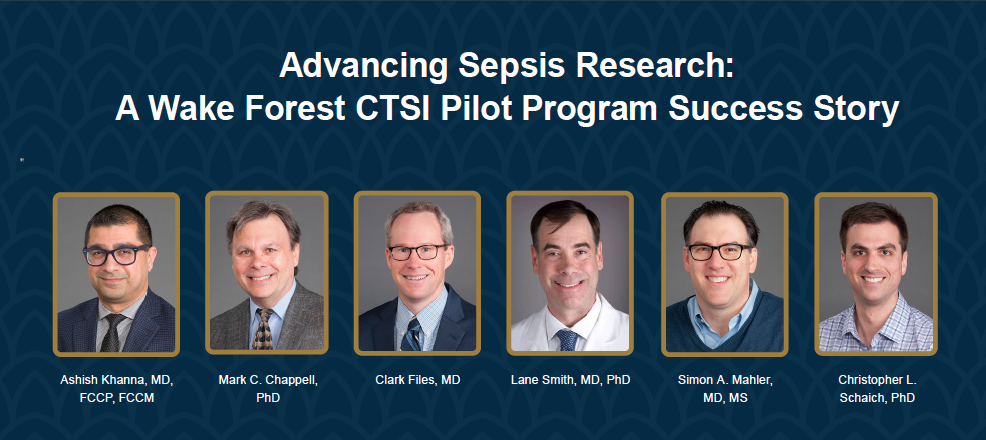
Dr. Ashish Khanna, a professor of Anesthesiology at Wake Forest University School of Medicine, received the 2024-2025 Science of Translation Pilot Award for his project ‘Precision-Based Renin Assessment in Septic Shock Outcomes.3 This research initiative has fostered collaboration across multiple sites, including the Hypertension Center, Medical ICU, and Emergency Department (ED) at the Winston campus, as well as Atrium Health Charlotte and the High Point Medical Center ICU. The High Point Medical Center ICU is a high-volume center for septic shock and sepsis research where Dr. Khanna works as a critical care physician. These partnerships have supported patient screening, enrollment, and biomarker analysis. The initiative encompasses a collective effort among many providers and support staff. Dr. Khanna’s current project focuses on understanding dysfunction within the renin-angiotensin-aldosterone system (RAAS) in septic shock. The goal is to find a set of RAAS biomarkers that can more precisely predict patient outcomes and guide early therapeutic interventions to improve care for septic shock. Research coordinators from the ED and ICU at the three participating hospitals use electronic health records to screen patients and coordinate logistics.3 Though still undergoing refinement, this system has enhanced efficiency and yielded valuable insights for improving future clinical trials.
The RAAS helps the body control blood pressure and fluid balance. In septic shock, this system is activated early as the body tries to support blood flow to vital organs. Researchers believe that certain RAAS components, like renin, could serve as useful biomarkers because high levels have been linked to worse outcomes, including higher risk of death.2 When renin levels rise, other parts of the RAAS may not respond strongly enough to help stabilize blood pressure or support the immune system. In some patients, this imbalance may make the condition worse. There is evidence that in septic shock the RAAS may shift toward a pathway that causes more blood vessel relaxation, which can further lower blood pressure.2
Significance
This project aims to advance the treatment of septic shock by finding more precise ways to guide care using biomarkers from the RAAS. By improving our understanding of how this system behaves in critically ill patients, the research could lead to more targeted and effective use of medications like Angiotensin II. This would help patients by improving survival rates, reducing complications, and providing clinicians with better tools for making treatment decisions.4 In the long term, this work has the potential to shape clinical guidelines and improve outcomes for thousands of patients worldwide who face this life-threatening condition.
This research directly benefits populations who are at higher risk of developing and dying from septic shock, including older adults, individuals with chronic illnesses, and those with limited access to advanced critical care.1 The project aims to improve patient outcomes by personalizing treatment strategies based on RAAS biomarkers that can be used to better assess a patient’s condition.
The development of rapid, point-of-care testing for biomarkers like renin could enable earlier and more exact treatment decisions in a wide range of healthcare settings, including under-resourced hospitals and emergency departments.5 This would help reduce disparities in care and outcomes, particularly for vulnerable and underserved communities. Ultimately, the research promotes health equity by striving to ensure that all patients—regardless of demographic or accessibility to care— receive prompt, targeted, and effective treatment for septic shock.
Benefits
Demonstrated benefits are those that have been observed and are verifiable.
Potential benefits are those logically expected with moderate to high confidence.
Clinical & medical benefits
Contribute to the development of future clinical guidelines for the management of septic shock by finding and validating RAAS-based biomarkers. potential.
Inform the development of new therapeutic procedures for managing septic shock, specifically proposing to use renin levels to find patients who are most likely to benefit from Angiotensin II (Ang II) therapy. potential.
Identified and validated biomarkers, specifically renin and other RAAS-related peptides, as critical tools for diagnosing and managing septic shock. demonstrated.
This research has clinical implications. The framework for these implications was derived from the Translational Science Benefits Model created by the Institute of Clinical & Translational Sciences at Washington University in St. Louis.6
Clinical
This research has shown meaningful impact across multiple TSBM benefits in the Clinical domain. It lays the foundation for future clinical recommendations by proposing a biomarker-guided approach to septic shock treatment, particularly the use of renin levels to guide treatment choices to correct the dysfunctional RAAS. This could standardize care and improve outcomes, especially in high-risk populations. The project proposes using Angiotensin II in patients with elevated renin to manage septic shock in a novel, personalized way. This offers a more effective and targeted intervention than the current one-size-fits-all approach that does not incorporate RAAS biomarkers into analysis to account for varying patient renin levels. Finally, this research names and validates RAAS biomarkers, such as renin and Ang I/Ang II ratios, as tools for diagnosis, prognosis, and treatment guidance. These biomarkers not only enhance clinical decision-making but also support the development of rapid, point-of-care diagnostic tools. The benefits of this research are expected to be realized in critical care settings globally, particularly in ICUs where septic shock is a leading cause of death. The primary beneficiaries include critically ill patients, especially those from underserved or high-risk populations, as well as clinicians seeking more effective treatment strategies for septic shock. As the findings are translated into clinical practice and future trials, the societal impact could include improved septic shock survival rates, reduced healthcare disparities, and more efficient use of medical resources.
Lessons Learned
Beyond fostering collaboration, the Clinical and Translational Science Institute (CTSI) Pilot Program has laid the groundwork for larger clinical trials and serves as a foundation for future research initiatives, including the Advocate Health National Center for Clinical Trials (NCCT). Dr. Khanna states, “For me personally, I am honored and thrilled to be working with my colleagues who see the same clinical problems in patients with septic shock and share common ideologies of research. And that I get to work with Mark Chappell, who has pioneered research with the RAAS and has taught me so much in the process, is the perfect icing on the cake. In 2017, I led and published a significant clinical trial of Angiotensin II, an exogenous synthetic vasopressor that modulates the RAAS. Returning to reexamine the mechanics of the RAAS with Mark and his expert team has been exceptionally rewarding. Serendipity, reverse causation, inspiration and gratitude all in one!”
-
Septic shock. NHS inform. Accessed August 11, 2025. https://www.nhsinform.scot/illnesses-and-conditions/blood-and-lymph/septic-shock/.
-
Schaich CL, Leisman DE, Goldberg MB, Filbin MR, Khanna AK, Chappell MC. Dysfunction of the Renin-Angiotensin-Aldosterone System in Human Septic Shock. Peptides. 2024;176:171201. doi:10.1016/j.peptides.2024.171201,
-
Advancing Sepsis Research: A Wake Forest CTSI Pilot Program Success Story. Research Administration / CTSI. Accessed August 11, 2025. https://ctsi.wakehealth.edu/announcements/2025/04/ctsi-pilot-program-success-story—ashish-khanna.
-
Legrand M, Khanna AK, Ostermann M, et al. The renin-angiotensin-aldosterone-system in sepsis and its clinical modulation with exogenous angiotensin II. Crit Care. 2024;28(1):389. doi:10.1186/s13054-024-05123-7.
-
Kotani Y, Chappell M, Landoni G, Zarbock A, Bellomo R, Khanna AK. Renin in critically ill patients. Annals of Intensive Care. 2024;14(1):79. doi:10.1186/s13613-024-01304-3
-
Luke DA, Sarli CC, Suiter AM, et al. The Translational Science Benefits Model: a new framework for assessing the health and societal benefits of clinical and translational sciences. Clin Transl Sci. 2018;11(1):77-84. doi:10.1111/cts.12495.
Supplemental Resources
-
Chappell MC, Schaich CL, Busse LW, et al. Higher circulating ACE2 and DPP3 but reduced ACE and angiotensinogen in hyperreninemic sepsis patients. Clin Sci (Lond). 2025;139(1):43-53. doi:10.1042/CS20242168.
-
Chappell MC, Schaich CL, Busse LW, et al. Stronger association of intact angiotensinogen with mortality than lactate or renin in critical illness: post-hoc analysis from the VICTAS trial. Critical Care. 2024;28(1):333. doi:10.1186/s13054-024-05120-w.
-
Busse LW, Schaich CL, Chappell MC, et al. Association of Active Renin Content With Mortality in Critically Ill Patients: A Post hoc Analysis of the Vitamin C, Thiamine, and Steroids in Sepsis (VICTAS) Trial. Crit Care Med. 2024;52(3):441-451. doi:10.1097/CCM.0000000000006095.
-
Te Riet L, van Esch JHM, Roks AJM, van den Meiracker AH, Danser AHJ. Hypertension: renin-angiotensin-aldosterone system alterations. Circ Res. 2015;116(6):960-975. doi:10.1161/CIRCRESAHA.116.303587.
-
Chappell MC. Biochemical evaluation of the renin-angiotensin system: the good, bad, and absolute? Am J Physiol Heart Circ Physiol. 2016;310(2):H137-152. doi:10.1152/ajpheart.00618.2015.
-
Bitker L, Burrell LM. Classic and Nonclassic Renin-Angiotensin Systems in the Critically Ill. Crit Care Clin. 2019;35(2):213-227. doi:10.1016/j.ccc.2018.11.002.
-
Leśnik P, Łysenko L, Krzystek-Korpacka M, Woźnica-Niesobska E, Mierzchała-Pasierb M, Janc J. Renin as a Marker of Tissue Perfusion, Septic Shock and Mortality in Septic Patients: A Prospective Observational Study. Int J Mol Sci. 2022;23(16):9133. doi:10.3390/ijms23169133.
-
Forrester SJ, Booz GW, Sigmund CD, et al. Angiotensin II Signal Transduction: An Update on Mechanisms of Physiology and Pathophysiology. Physiol Rev. 2018;98(3):1627-1738. doi:10.1152/physrev.00038.2017.